
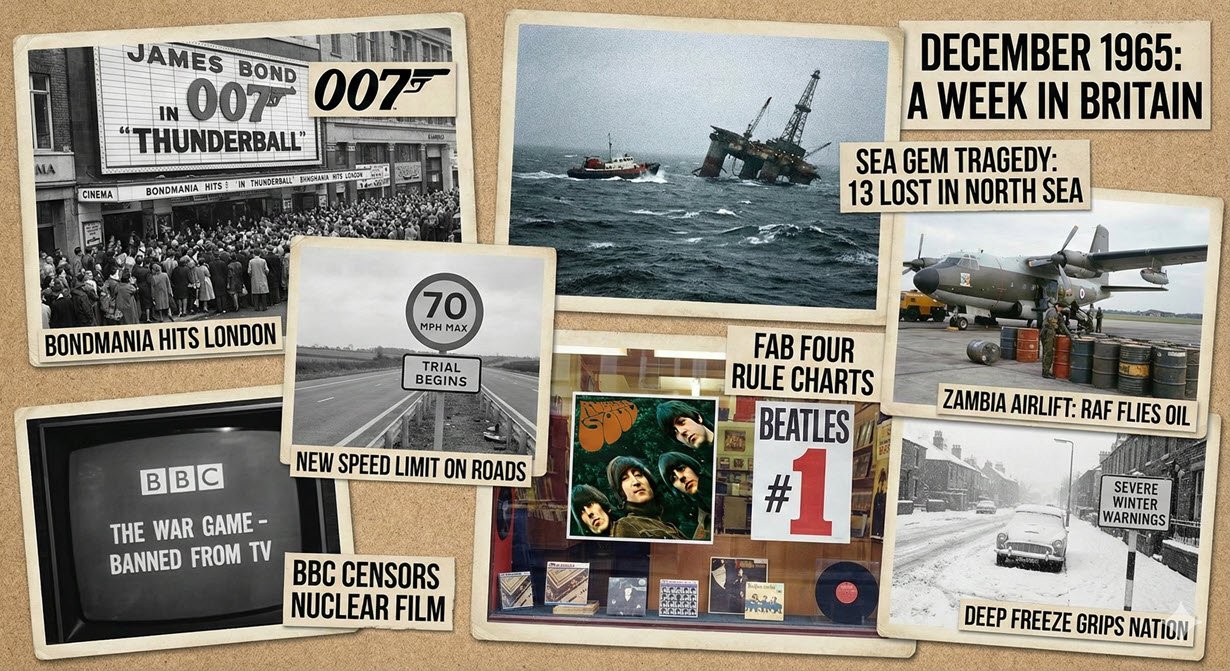
December 29, 1965, remains a standout date in the British consciousness, serving as a crossroads where the glamour of the "Swinging Sixties" collided with sobering industrial realities and the chilling tensions of the Cold War. It was a day that perfectly encapsulated a nation in transition—balancing the thrill of new technology and cultural exports against the heavy responsibilities of global diplomacy and public safety.
The UK Premiere of Thunderball
The London premiere of the fourth James Bond installment, Thunderball, solidified 007 as a global cultural juggernaut. Starring Sean Connery, the film arrived at the height of "Bondmania," drawing massive crowds to the West End who were eager to witness the cutting-edge underwater cinematography and iconic gadgets like the jetpack. Beyond mere entertainment, the film represented a burgeoning British soft power, projecting an image of sophistication, daring, and technological prowess to the rest of the world during an era of intense international rivalry. The film’s massive success during this holiday week shattered box office records, proving that the Bond franchise was not just a fad, but a foundational pillar of modern cinematic history.
Aftermath of the Sea Gem Rig Disaster
The festive spirit of late December was severely dampened by the ongoing recovery efforts following the collapse of the Sea Gem, Britain's first offshore oil rig. Just two days prior, the structure had capsized in the treacherous waters of the North Sea, leading to the tragic loss of 13 lives. By December 29, the nation was gripped by the harrowing accounts of survivors and the logistical challenges of searching for the missing in freezing conditions. This disaster served as a brutal wake-up call regarding the dangers of the burgeoning offshore energy industry, eventually leading to a total overhaul of safety regulations and the establishment of more rigorous legislative frameworks to protect workers in the North Sea.
First Week of the 70mph Speed Limit
December 29 marked a pivotal moment for British motorists as they navigated the first week of the newly introduced national 70mph speed limit trial. Previously, many of the country's motorways had no formal speed limit, but a series of horrific, fog-related multi-car pileups prompted the government to intervene. While the measure was initially met with significant resistance from driving enthusiasts who viewed it as an infringement on personal liberty, the trial was a response to an urgent need for public safety. This experimental period transformed the British driving culture, forcing a shift in how the public perceived road safety and the government’s role in regulating the high-speed capabilities of modern automobiles.
The Beatles Dominate the UK Charts
In the final days of 1965, The Beatles exerted an almost total command over the British music scene, holding the #1 spot on both the singles and album charts. Their double A-side single, "Day Tripper" / "We Can Work It Out," was the soundtrack to the holiday season, while the groundbreaking album Rubber Soul signaled a sophisticated evolution in their sound. This period represented more than just commercial success; it was the moment the "Fab Four" transitioned from pop idols to serious artists. Their dominance during this week highlighted the incredible momentum of British youth culture and its ability to redefine global music standards, making 1965 a definitive year for the Merseybeat revolution.
Rhodesia Oil Embargo Crisis
On the diplomatic front, the UK government was deeply entrenched in the fallout of Rhodesia’s Unilateral Declaration of Independence. By December 29, Prime Minister Harold Wilson’s administration was aggressively enforcing a total oil embargo to pressure Ian Smith’s regime. This necessitated a massive, complex logistical operation known as the Zambia Airlift, where the RAF and civilian aircraft flew fuel into landlocked Zambia to prevent an economic collapse. The crisis was a major test of British post-colonial influence and Commonwealth solidarity, illustrating the difficult and often messy process of decolonization. The events of this day highlighted the UK’s struggle to maintain international order while navigating the sensitive racial and political tensions of Southern Africa.
Controversy Over The War Game
At the BBC, tensions reached a boiling point regarding the broadcast of The War Game, a television film directed by Peter Watkins. The film provided a terrifyingly realistic depiction of the effects of a nuclear attack on Britain, utilizing a pseudo-documentary style that many officials found too disturbing for the general public. On this day, the debate over whether to air the film was a focal point of internal and external scrutiny. Ultimately, the BBC decided to ban the film from television—a ban that would last for twenty years. This act of censorship sparked a national conversation about the government’s transparency regarding the realities of the Cold War and the psychological impact of nuclear proliferation on the civilian population.
Winter Weather Warnings
As the year drew to a close, a punishing cold snap took hold of the British Isles, with December 29 seeing some of the most severe weather warnings of the season. Heavy snowfall and dense, freezing fog blanketed much of Northern England and Scotland, paralyzing transport networks and leaving holiday travelers stranded. The "Great Freeze" of late 1965 tested the nation's infrastructure, causing widespread power fluctuations and dangerous road conditions that hampered the post-Christmas return to work. For many, the day was defined by the struggle to stay warm and the resilience required to navigate a landscape temporarily halted by the unpredictable and harsh British winter weather, adding a layer of physical hardship to an already eventful week. The year 1965 was a period of profound social and political transition, marked by the escalation of the Vietnam War, the peak of the Space Race, and historic strides in the American Civil Rights Movement. Below is a chronological list of significant events from that year, each summarized to provide context on its global or cultural impact.
Chronicle of 1965: A Year in Review
Death of Winston Churchill (January 24)
The passing of the former British Prime Minister at age 90 marked the end of an era for the United Kingdom and the world. Churchill was the primary symbol of British resistance against Nazi Germany during World War II, and his leadership was instrumental in the Allied victory. His state funeral, held at St. Paul’s Cathedral, was one of the largest gatherings of world statesmen in history, with representatives from 112 countries attending to pay their respects to the "Greatest Briton."
Canada Adopts a New Flag (February 15)
After years of intense political debate known as the "Great Flag Debate," Canada officially inaugurated its current national flag, featuring a red maple leaf on a white background with two red borders. The new design replaced the Canadian Red Ensign, which featured the British Union Jack. This change symbolized Canada’s growing sense of independent national identity and its desire to move away from colonial-era symbols toward a more distinct and inclusive representation of its diverse population.
Assassination of Malcolm X (February 21)
The visionary and controversial Black nationalist leader was assassinated at the age of 39 while preparing to address the Organization of Afro-American Unity in Manhattan’s Audubon Ballroom. Having recently broken away from the Nation of Islam and moderated some of his views on racial integration, Malcolm X remained a powerful voice for Black empowerment. His death was a massive shock to the Civil Rights Movement, leaving a legacy that continued to inspire the Black Power movement and subsequent generations of activists.
Premiere of The Sound of Music (March 2)
One of the most successful and beloved musical films in history, The Sound of Music, starring Julie Andrews, premiered in New York City. Based on the true story of the von Trapp family in Nazi-occupied Austria, the film became a global sensation, winning five Academy Awards, including Best Picture. Its massive commercial success helped save 20th Century Fox from financial ruin and cemented its place in popular culture with timeless songs like "Do-Re-Mi" and "My Favorite Things."
The Selma to Montgomery Marches (March 7–25)
These three marches represented a pivotal turning point in the U.S. Civil Rights Movement. The first march, on March 7, became known as "Bloody Sunday" after nonviolent protestors were brutally attacked by state troopers on the Edmund Pettus Bridge. The national outcry following the televised violence prompted President Lyndon B. Johnson to provide federal protection for a subsequent, successful march. These events directly catalyzed the passage of the Voting Rights Act later that year, exposing the systemic disenfranchisement of Black Americans to the world.
Arrival of U.S. Ground Troops in Vietnam (March 8)
In a significant escalation of the Vietnam conflict, 3,500 U.S. Marines landed at Da Nang, marking the first time American combat troops were officially deployed to South Vietnam. Prior to this, U.S. involvement had been limited to "military advisors." This move signaled the "Americanization" of the war, leading to a massive increase in troop levels and a protracted conflict that would deeply divide American society and shape global politics for the next decade.
First Human Spacewalk (March 18)
Soviet cosmonaut Alexei Leonov made history as the first person to step out of a spacecraft into the vacuum of space. During the Voskhod 2 mission, Leonov floated outside the capsule for 12 minutes, tethered by a short cable. The feat was nearly fatal; his spacesuit expanded in the vacuum, making it almost impossible for him to re-enter the airlock. Despite the risks, the mission was a major propaganda victory for the USSR, demonstrating their early lead in the Space Race.
Launch of the "Early Bird" Satellite (April 6)
Intelsat I, nicknamed "Early Bird," became the first commercial communications satellite to be placed in geostationary orbit. It revolutionized global communications by enabling live transatlantic television broadcasts and providing 240 telephone circuits. Before Early Bird, intercontinental communication relied on expensive and limited undersea cables. Its successful operation proved that satellites could provide reliable, high-capacity commercial services, laying the technological foundation for the modern interconnected world we live in today.
First American Spacewalk (June 3)
Following the Soviet achievement earlier in the year, NASA astronaut Edward White became the first American to walk in space during the Gemini 4 mission. White spent 23 minutes maneuvering outside the spacecraft using a handheld oxygen-jet gun. He enjoyed the experience so much that he famously expressed his reluctance to return to the capsule. This milestone was a critical step for NASA, proving that American astronauts could perform the extravehicular activities necessary for future lunar missions.
Signing of the Voting Rights Act (August 6)
President Lyndon B. Johnson signed this landmark piece of federal legislation into law, which aimed to overcome legal barriers at the state and local levels that prevented African Americans from exercising their right to vote. The Act outlawed discriminatory practices such as literacy tests and provided for federal oversight of voter registration in areas with a history of discrimination. It is widely considered one of the most effective pieces of civil rights legislation in U.S. history, fundamentally transforming American democracy.
Independence of Singapore (August 9)
In a rare historical event, Singapore gained independence after being expelled from the Federation of Malaysia. Following years of ideological and racial tensions between Singapore’s ruling People's Action Party and the federal government in Kuala Lumpur, the Malaysian Parliament voted to sever ties. Prime Minister Lee Kuan Yew tearfully announced the separation on television, facing the daunting task of building a sovereign nation without natural resources. Against the odds, Singapore would eventually transform into a global financial powerhouse.
The Watts Riots (August 11–16)
A violent confrontation between Los Angeles police and residents of the predominantly Black Watts neighborhood ignited six days of unrest. Triggered by a traffic stop that escalated into violence, the riots were a symptom of deep-seated frustrations over police brutality, unemployment, and poor housing conditions. The unrest resulted in 34 deaths and over $40 million in property damage. It served as a stark reminder that the fight for civil rights was not limited to the South but was a national crisis.
The Beatles at Shea Stadium (August 15)
The Beatles performed for a record-breaking crowd of 55,600 fans at New York’s Shea Stadium, marking the peak of "Beatlemania." This was the first major outdoor stadium concert in rock history, proving that large-scale musical events could be both technically feasible and highly profitable. The screaming of the fans was so loud that the band could not hear their own instruments through the primitive sound system. This historic night fundamentally changed the concert industry and how pop music was experienced.
The Indo-Pakistani War (August–September)
This conflict, also known as the Second Kashmir War, began following Pakistan's Operation Gibraltar, which was designed to precipitate an insurgency against Indian rule in Jammu and Kashmir. The war saw the largest engagement of armored vehicles and the largest tank battle since World War II. After weeks of intense fighting and thousands of casualties, the United Nations brokered a ceasefire. The war ended in a stalemate, but it solidified the territorial disputes that continue to define relations between the two nations.
The Great Northeast Blackout (November 9)
A massive power failure plunged over 30 million people across the Northeastern United States and Ontario, Canada, into total darkness for up to 13 hours. Triggered by a faulty relay at a power plant near Niagara Falls, the blackout stalled subways, trapped people in elevators, and shut down major television stations. While the event caused widespread disruption, it was remarkably peaceful, with many citizens helping one another. It led to significant reforms in the management and reliability of the North American power grid.
Rhodesia’s Unilateral Declaration of Independence (November 11)
The white-minority government of Rhodesia (now Zimbabwe), led by Ian Smith, unilaterally declared independence from the United Kingdom to avoid transitioning to a "one man, one vote" system that would empower the Black majority. This was the first such declaration by a British colony since the United States in 1776. The move was declared illegal by the UK and the UN, leading to years of international sanctions and a protracted civil war that eventually ended with majority rule in 1980.
Release of Rubber Soul (December 3)
The Beatles released their sixth studio album, Rubber Soul, which is widely regarded as a turning point in music history. The album moved away from the band’s earlier "mop-top" pop sound toward more complex, experimental, and introspective themes. Incorporating instruments like the sitar and exploring more sophisticated lyrical narratives, Rubber Soul influenced countless other artists and set the stage for the psychedelic rock era. It transformed the "pop album" from a collection of singles into a cohesive, artistic statement.